
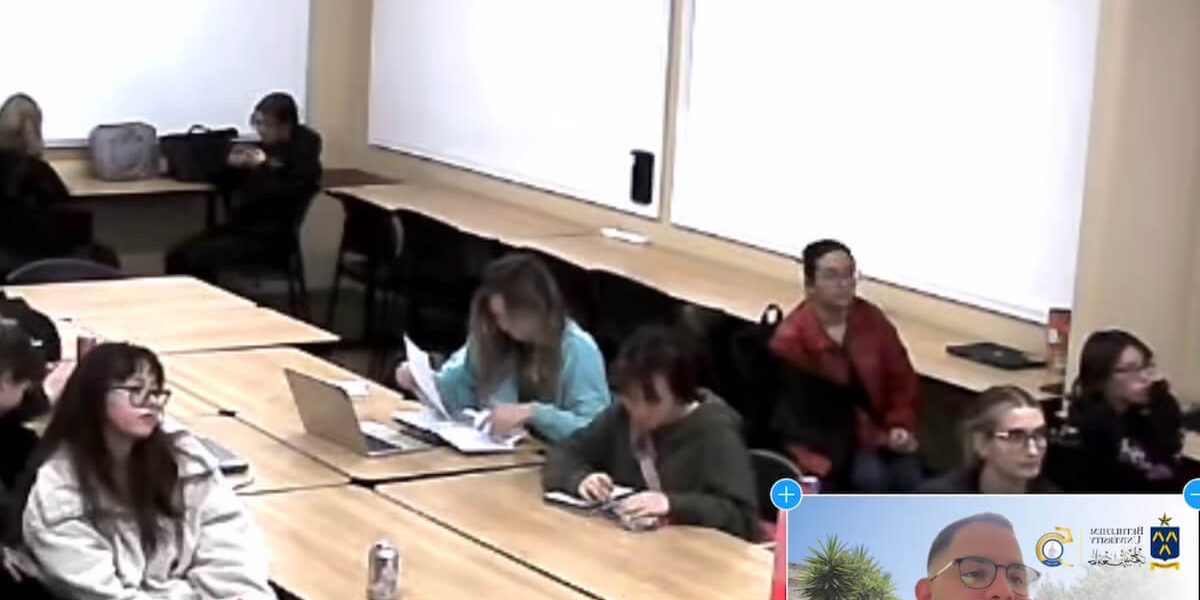
On Wednesday, 19 November 2025, Mr. Layth R. Awwad, faculty member in the Department of English at Bethlehem University, was invited once again as a guest author in Ms. Electra Aguirre’s creative writing class at Colorado State University Pueblo. His participation reflects Bethlehem University’s commitment to fostering academic excellence, global engagement, and intellectual exchange that extends far beyond its campus.
Although this is not his first time joining the course, this session took on a distinctly new direction, one centered on experimentation, creative constraints, and how writers discover form in an age of overwhelming freedom.
During the hour-long session, Mr. Awwad shared selections from both his short fiction and his poetry, offering students a glimpse into the different modes he works in as a writer. He spoke about how his recent poetic work has blended written and visual communication, treating the page itself as a space for meaning, rhythm, and imagery. As a Palestinian writer, he also reflected on how his sense of place, memory, and cultural inheritance naturally shape his voice and presence on the page, sometimes consciously, sometimes quietly.
This exploration of visuality and voice became a starting point for a broader conversation about how writers can use form not simply as a container, but as a partner in creativity. One of the central ideas he discussed was the role of creative limitations. In a world where we can write anywhere, with our phones, laptops, notebooks, or even with the assistance of AI, Mr. Awwad reflected on how limitless access can sometimes reduce our motivation to create. Instead, he encouraged students to intentionally embrace small constraints, challenges, and playful boundaries to spark imaginative thinking. These limitations, he suggested, often open doors to unexpected discoveries and poetic possibilities.
The session concluded with an open Q&A, where students asked about the writing process, inspiration, experimentation, and the relationship between self-expression and craft. The discussion touched lightly on themes such as embracing complexity, noticing the world closely, and the value of allowing ourselves to write from the contradictions we carry, ideas that resonated deeply with the class’s ongoing work in creative writing.
Mr. Awwad’s participation exemplifies Bethlehem University’s mission to cultivate thoughtful, socially engaged scholars and creators who contribute meaningfully to global conversations in literature, culture, and education. Through such international collaborations, the University continues to amplify Palestinian voices and foster academic dialogue that inspires deeper understanding across borders.